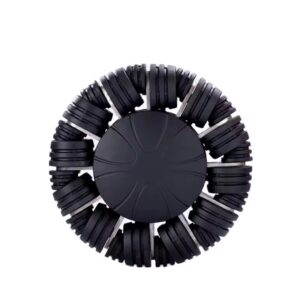
Mecanum Wheels vs. Differential Drive: The Ultimate AGV Steering Guide for Engineers
For AGV robots, Differential Drive is cost-effective but limited in agility. Mecanum Wheels offer maximum mobility but are complex and sensitive to floor conditions.
The Industrial Standard: For most modern warehouse AGVs and smart mobility platforms, Omni Wheels provide the perfect balance—offering 360° movement with higher stability, simpler control, and better obstacle clearance.
- Differential Drive: The Traditional Workhorse
A differential drive system is the most common AGV structure, using two independent powered wheels.
How it works: Direction is controlled by varying the relative rate of rotation of the wheels.
✅ Pros: Low cost, simple mechanical design, and high load capacity.
❌ Cons: Cannot move sideways (strafing). Requires a larger turning radius, which limits efficiency in narrow warehouse aisles. - Mecanum Wheels: Maximum Agility, Higher Complexity
Mecanum wheels use 45-degree angled rollers to allow a robot to move in any direction without changing its heading.
✅ Pros: Incredible maneuverability in tight spaces and high positioning accuracy.
❌ Cons: High complexity and cost. The small rollers are prone to wear and struggle with floor gaps or uneven surfaces. They also require complex synchronized control algorithms. - The “Sweet Spot”: Why Omni Wheels Win in Industrial AGVs
While Mecanum wheels are popular in labs, Industrial Omni Wheels have become the preferred choice for warehouse automation and smart mobility for several reasons:
Superior Stability: Unlike Mecanum rollers, Omni-wheel rollers are perpendicular to the axis, providing a more stable contact point under heavy loads.
Simplified Control: Achieving 360° movement with Omni wheels is mathematically simpler and more reliable for long-term autonomous operation.
Elevator & Gap Ready: With larger wheel diameters (like 8″ and 10″), Omni wheels can bridge elevator gaps and floor joints that would trap smaller Mecanum rollers.
Maintenance: Easier to clean and maintain in dusty industrial environments.
- Engineering Comparison Table
| Feature | Differential Drive | Mecanum Wheels | Omni Wheels (Recommended) |
| Movement | Fwd/Bwd + Rotation | Full Omnidirectional | Full Omnidirectional |
| Control Complexity | Simple | Very High | Moderate & Stable |
| Floor Adaptability | High | Low (Sensitive to Gaps) | High (Excellent Gap Crossing) |
| Durability | High | Medium | Industrial-Grade High |
| Total Cost (ROI) | Lowest | Highest | Best Value for Performance |
| Best Application | Basic AGV / Towing | High-Precision Robotics | Warehouse AGVs & Smart Mobility |
- Which System Should You Choose?
🏭 Choose Differential Drive if: You have a strict budget and operate in wide-open spaces where sideways movement isn’t required.
🚀 Choose Mecanum Wheels if: You are building a small-scale, high-precision robot that only operates on perfectly flat, clean laboratory floors.
⚖️ Choose Omni Wheels if: You are developing Industrial AGVs, Logistics Robots, or Smart Power Chairs that need to navigate tight spaces, cross elevator gaps, and carry heavy loads reliably 24/7. - Pro-Grade Wheel Solutions for Your AGV Project
Choosing the right hardware is as important as the drive logic. We specialize in high-load, aluminum-core omni wheels for industrial excellence:
[8-Inch (210mm) Omni Wheels]: Perfect for compact AGVs and service robots (Load: 100-150kg/wheel).
[10-Inch (259mm) Omni Wheels]: The flagship choice for autonomous wheelchairs and heavy-duty warehouse robots. Optimized for elevator gap safety.
Custom OEM Solutions: We provide 3D STEP files and technical support for global engineering teams.
Need the CAD files for your next AGV design?
[Request 3D STEP Files] | [Get a Bulk Quote Today]

 English
  Japanese